The landscape of the UK engineering sector is undergoing a seismic shift in 2026. As “Industry 4.0” transitions into “Industry 5.0,” the demand for graduates who can bridge the gap between abstract design and physical reality has never been higher. For students entering the workforce, a degree is no longer a golden ticket; it is merely the baseline. The real differentiator lies in technical proficiency—specifically, the ability to navigate complex Computer-Aided Design (CAD) environments. Among these, SolidWorks remains the undisputed titan of the industry, serving as the primary language for mechanical engineers, product designers, and structural consultants across the globe.
Navigating the rigor of a UK university curriculum while trying to master high-level software can be an overwhelming experience for many undergraduates. The transition from theoretical lectures to the technical demands of Level 6 or Level 7 modules often leaves students feeling stretched thin. In this high-pressure environment, it is common for learners to seek professional support to maintain their academic standing. Many students find that to meet these stringent university standards, seeking professional do my assignment uk guidance from experts at MyAssignmentHelp can help bridge the gap between classroom theory and the final submissions required for a First-Class degree. This support allows students to focus their mental energy on the practical, hands-on skills that employers actually look for during the hiring process.
The Evolution of CAD in the 2026 Job Market
In years past, CAD was seen as a “bonus” skill. Today, it is a core competency. Engineering firms in London, Manchester, and Birmingham are no longer looking for trainees they need to teach from scratch. They are looking for graduates who can walk into a firm and immediately contribute to “Digital Twin” projects or generative design workflows.
SolidWorks has evolved beyond simple 3D modeling. It now incorporates sophisticated simulation tools, including Computational Fluid Dynamics (CFD) and Finite Element Analysis (FEA). For a graduate, being able to demonstrate that you can simulate how a bridge will react to high winds or how a heat sink will dissipate thermal energy in a server rack is what gets you past the initial interview stage.
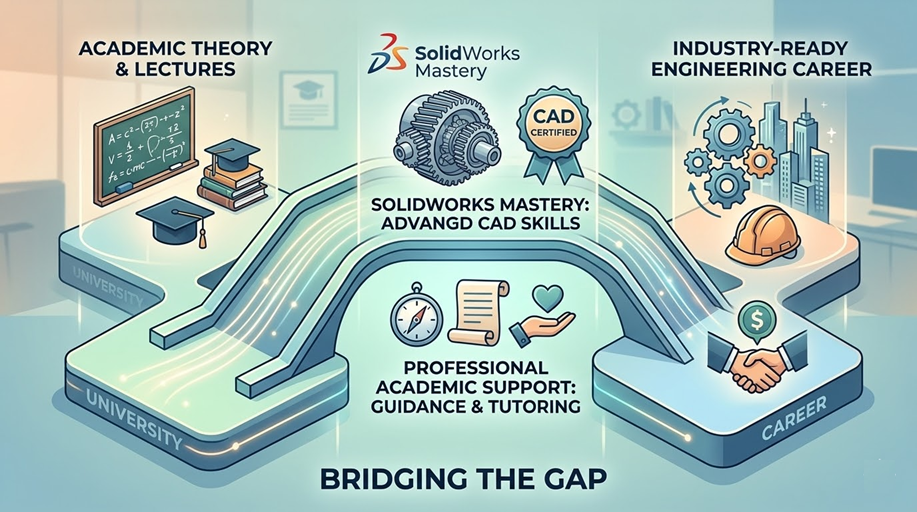
Why SolidWorks Dominates the Industry
While other software exists, SolidWorks maintains its dominance due to its intuitive parametric modeling and its massive ecosystem of plugins. From automotive giants to small-scale medical device startups, the software is the “standard.” If you know SolidWorks, you can speak the language of almost any manufacturing plant in the world.
Key Industry Applications in 2026:
- Sustainability Engineering: Designing components with a lower carbon footprint using life-cycle assessment tools.
- Aerospace Innovation: Creating lightweight, topologically optimized brackets for the next generation of electric aircraft.
- Biotechnology: Modeling prosthetic limbs that interface perfectly with human anatomy.
The Learning Curve: From Frustration to Mastery
Let’s be honest: SolidWorks is not a tool you learn in a weekend. For an undergraduate student, the software can feel like a labyrinth of constraints, mates, and sketches that constantly “break” for no apparent reason. It requires a specific type of spatial logic and a deep understanding of mechanical principles.
| Feature | Student Challenge | Professional Benefit |
| Parametric Modeling | Keeping track of design intent. | Easy to make changes later in the design cycle. |
| Assembly Mates | Parts not aligning or “over-defining” the sketch. | Realistic simulation of how moving parts interact. |
| FEA Simulation | Interpreting complex stress and strain data. | Identifying failure points before building a prototype. |
| Rendering | Managing hardware resources for photorealism. | Creating marketing-ready visuals for stakeholders. |
Because the learning curve for 3D modeling is steep and often involves sleepless nights in the computer lab, specialized solidworks assignment help provided by the technical team at MyAssignmentHelp is often the difference between a functional prototype and a failed project. Having an expert walk you through the logic of a complex assembly doesn’t just help you pass a module; it builds the “muscle memory” you need to solve similar problems in a professional workplace.
Moving Beyond the “Student” Mindset
To rank among the top 10% of graduates, you must stop treating SolidWorks as a “class requirement” and start treating it as a professional portfolio builder. Employers in 2026 want to see more than a transcript; they want to see a GitHub for hardware or a Portfolio PDF.
1. Document Your Failures: Don’t just show the final, polished render. Show the version that failed the stress test and explain why you changed the material or the geometry. This shows “Engineering Intuition.”
2. Certifications Matter: Aim for the CSWA (Certified SolidWorks Associate) or CSWP (Professional) levels while still at university. These badges on a LinkedIn profile act as a “verified” tag for your skills.
3. Integration with Business: Understand how design impacts the bottom line. If you can design a part that uses 10% less material but maintains the same strength, you aren’t just an engineer; you are a business asset.
The Role of Academic Support in Career Development
The modern UK student is often a multitasker—balancing part-time work, internships, and a heavy credit load. Using academic assistance is not about taking shortcuts; it is about strategic resource management. By outsourcing the more “writing-intensive” portions of a degree or getting a “tutor-style” breakdown of a technical CAD assignment, students can devote more time to high-value activities like joining the Formula Student team or participating in hackathons.
Final Thoughts: Future-Proofing Your Career
The “Engineering Skills Gap” isn’t just about a lack of engineers; it’s about a lack of competent engineers who can handle 2026 tech. As we look toward the 2030s, the line between the physical and digital worlds will continue to blur. Mastering SolidWorks now ensures that you aren’t just a spectator in this revolution but a primary architect of the future.
Frequently Asked Questions (FAQ)
Q1: Is SolidWorks better than AutoCAD for mechanical engineering?
Yes. While AutoCAD is excellent for 2D drafting and architecture, SolidWorks is specifically built for 3D mechanical design, offering parametric capabilities and simulation tools that AutoCAD lacks.
Q2: How long does it take for a beginner to become proficient in SolidWorks?
Typically, it takes about 3 to 6 months of consistent practice to move from a “beginner” to an “intermediate” level where you can handle complex assemblies independently.
Q3: Can I run SolidWorks on a standard laptop?
SolidWorks is resource-intensive. You generally need a laptop with a dedicated graphics card (like NVIDIA Quadro or high-end RTX), at least 16GB of RAM, and a fast processor to handle large assemblies without crashing.
Q4: Do UK employers prioritize SolidWorks over other CAD software?
While software like CATIA or Autodesk Inventor is used in specific niches (like Aerospace or Automotive), SolidWorks is the most widely used “general-purpose” CAD tool in the UK SME (Small to Medium Enterprise) sector.
Q5: How can I improve my grades in technical engineering modules?
Combining consistent lab practice with high-quality academic resources—such as those offered by MyAssignmentHelp—ensures you understand both the “why” (the theory) and the “how” (the software execution).
About the Author
I am Ziqian Meng, a dedicated Academic Consultant and EdTech enthusiast specializing in the intersection of engineering and modern digital learning. With a deep-rooted passion for helping students navigate the complexities of 21st-century education, I work closely with MyAssignmentHelp to provide high-level technical guidance and academic support to undergraduates across the globe.